
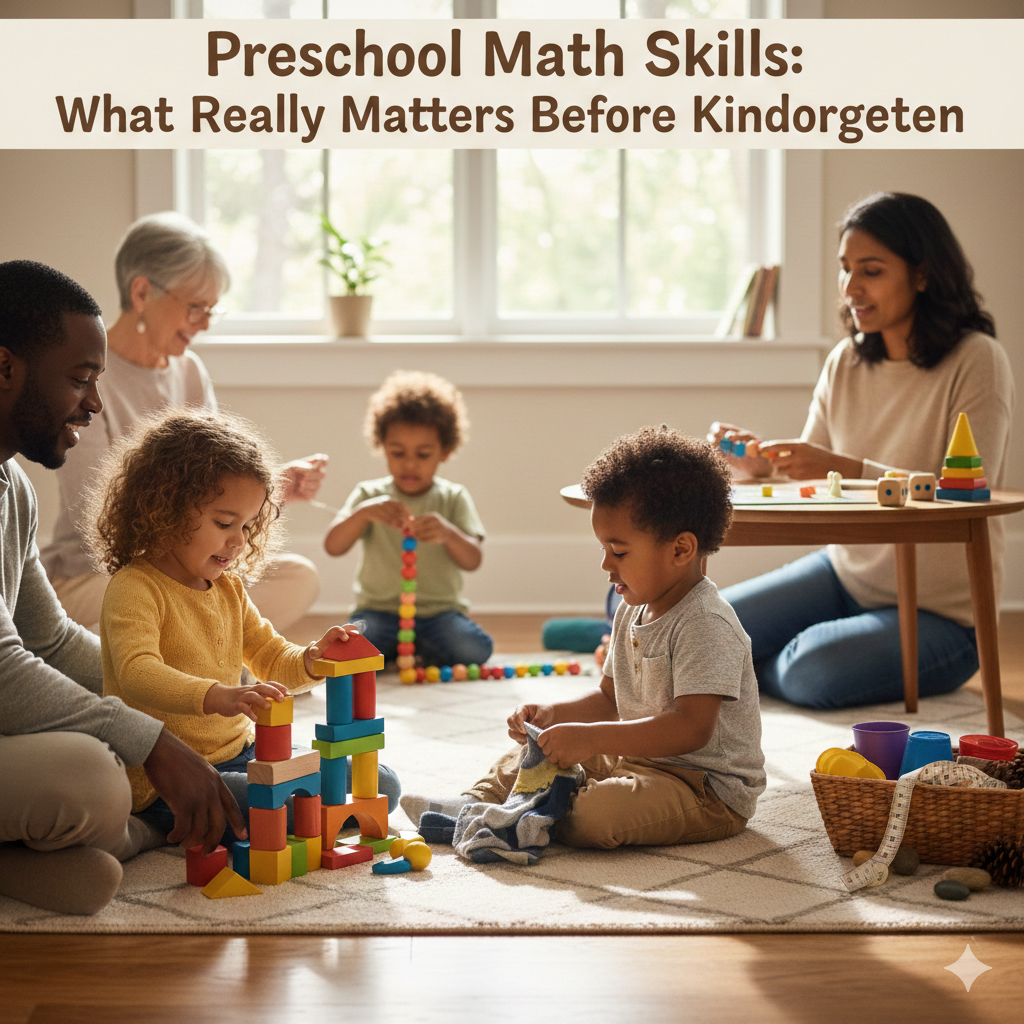
Preschool Math Skills: What Really Matters Before Kindergarten
If you have ever felt a twinge of anxiety watching another child count to twenty while yours is busy stacking blocks, you aren’t alone. In a world that feels increasingly competitive, it’s easy to feel like our preschoolers are already “behind” if they aren’t doing addition or identifying hexagons at age four.
Here is the good news: Math for preschoolers isn’t about memorization or paper-and-pencil drills. At this age, math is a way of seeing the world. It is about curiosity, exploration, and play. When your child insists on having the “bigger” half of a cookie or notices that your shirt has stripes just like theirs, they are already doing math.
This guide will help you understand what really matters in early math development and how you can support your child’s natural curiosity without a single worksheet in sight.
1. Understanding “Number Sense”
When we think of math, we often think of counting. But counting is actually just a small part of a much bigger concept called Number Sense.
Number sense is the ability to understand what numbers actually mean. It’s the difference between a child reciting the numbers 1 through 10 like a song and a child understanding that the word “three” represents three physical apples.
The Power of “Subitizing”
Have you ever rolled a die and known it was a five without actually counting the dots? That skill is called subitizing. It is a foundational math skill. Preschoolers start by recognizing small groups (like two crackers on a plate) without counting them one by one.
How to Practice at Home:
- The “How Many?” Game: While eating a snack, ask, “Can you give me two goldfish?”
- Dice Games: Playing simple board games with a single die helps children recognize dot patterns instantly.
- Counting Everything: Count the steps as you walk upstairs, the buttons on a coat, or the scoops of laundry detergent.
2. Counting: More Than Just the Alphabet Song
Many preschoolers can “count” to ten or twenty because they have memorized the sequence of words. This is called Rote Counting. While it’s a great start, the more important skill is One-to-One Correspondence.
This means your child understands that each object they touch gets exactly one number name. You might notice your child “counting” five items but saying numbers all the way to ten because their finger is moving faster than their voice. That’s a perfectly normal stage of development!
How to Practice at Home:
- Setting the Table: “We need four forks. One for Daddy, one for Mommy, one for you, and one for your sister.”
- Touch and Count: Encourage your child to touch each object as they say the number. This physically connects the word to the item.
- The “One More” Rule: If you have three toy cars, ask, “What happens if we add one more?”
3. Patterns: The Rhythm of Math
Mathematics is often described as the “science of patterns.” Recognizing patterns is the precursor to understanding algebra and advanced logic later in life. For a preschooler, a pattern is simply a predictable sequence.
Patterns help children make predictions. If they see a pattern of Red-Blue-Red-Blue, they learn to anticipate what comes next. This builds a sense of order and logic.
How to Practice at Home:
- Beading and Crafts: Use pasta shapes or colored beads to make “AB” patterns (Circle-Square-Circle-Square).
- Natural Patterns: Look for patterns in nature, like the stripes on a bee or the petals on a flower.
- Musical Patterns: Clap a rhythm (Clap, Pat, Clap, Pat) and ask your child to repeat it.
4. Shapes and Spatial Awareness
Geometry starts with playing with blocks. When children learn about shapes, they aren’t just learning names like “triangle” or “rectangle.” They are learning about attributes—the features that make a shape what it is (e.g., a triangle has three sides).
Spatial awareness is also key. This involves understanding how objects fit together in space. Can this big block fit on top of that small one? Will this puzzle piece fit if I turn it sideways?
How to Practice at Home:
- Shape Hunts: Go on a “Circle Hunt” around the house. Find the clock, the dinner plate, and the doorknob.
- Block Building: Give your child time for unstructured block play. Navigating how to balance a tower is a complex physics and math lesson.
- Puzzles: Doing puzzles is one of the best ways to build spatial reasoning.
5. Measurement and Comparison
Before children use rulers, they use Comparison. Preschool math involves understanding “more vs. less,” “bigger vs. smaller,” and “heavier vs. lighter.”
Cooking is a goldmine for measurement. Even if they aren’t reading the numbers on a measuring cup yet, they are seeing that two half-cups fill up one whole cup.
How to Practice at Home:
- Bath Time Science: Use different-sized containers in the bathtub. Ask, “Which one holds more water?”
- Comparison Talk: Use math words in daily life. “That tree is much taller than our house.” “Your backpack feels heavy today.”
- Sorting Laundry: Sorting socks by size or color is a mathematical task that involves categorizing and comparing.
6. Play vs. Worksheets: Why Play Wins
It is a common misconception that “serious” learning requires a desk and a pencil. For the developing brain of a three-to-five-year-old, worksheets are often too abstract and can actually lead to “math anxiety” early on.
Play is the “work” of childhood. When a child plays, they are experimenting. They are allowed to fail, retry, and discover solutions. A worksheet only has one right answer, but a pile of blocks has infinite mathematical possibilities.
If your child is building a bridge for their toy dinosaurs, they are calculating weight, balance, and length. That is much more “academic” than circling a picture of the number four.
7. Reassurance: Development is Not a Race
Developmental milestones are ranges, not deadlines. Just as some children walk at nine months and others at fifteen months, “math brains” wake up at different times.
One child might be obsessed with counting everything they see, while another is much more interested in the spatial challenge of building complex structures. Both are developing vital mathematical foundations.
If your child struggles to remember the name of a “rhombus” or skips the number seven when counting, take a deep breath. Their brain is busy building the underlying architecture. Consistency and exposure matter much more than perfect performance at age four.
Summary of Goals for Kindergarten Entry
While every school district is different, most teachers are looking for these “soft” math skills when a child enters Kindergarten:
- Counting to 10 or 20.
- Identifying basic shapes (Circle, square, triangle, rectangle).
- Recognizing small groups of objects (Subitizing).
- Using comparative words (More/less, bigger/smaller).
- Following a simple pattern.
The Most Important Skill
The most valuable thing you can give your child is a positive attitude toward math. If they see math as a fun puzzle to be solved rather than a chore to be completed, they will enter Kindergarten with the confidence they need to succeed.
Keep it light, keep it playful, and remember: you are already your child’s best teacher.